

What is Residential Thermal Insulation in Alicante and Why is it Key for the Mediterranean Climate?
Definition of Thermal Insulation
The residential thermal insulation refers to the set of solutions and materials that reduce heat flow through the building envelope (facades, roofs, floor slabs, and openings), minimizing heat losses and gains. In Alicante, it focuses on limiting thermal transmittance and eliminating thermal bridges to maintain a stable indoor temperature with less energy consumption.
Why it is Key for Alicante’s Mediterranean Climate
Alicante’s Mediterranean climate features long, hot summers, high solar radiation, and coastal humidity. Good insulation reduces summer heat gain, helps maintain indoor coolness, and decreases reliance on air conditioning. It also mitigates day-night fluctuations, providing comfort when outdoor temperatures vary rapidly.
Specific Benefits for Homes
Applied to facades and roofs (areas of greatest exposure), insulation achieves energy savings, greater thermal comfort, and reduced risks of condensation due to environmental humidity. In renovations, solutions such as insulating existing cavities or external systems help improve the home without losing usable space; in new construction, a design with low conductivity and proper airtightness maximizes insulation performance in Alicante.
Types and Materials of Residential Thermal Insulation in Alicante: ETICS, Cavity Wall Insulation, Roofs, and Windows
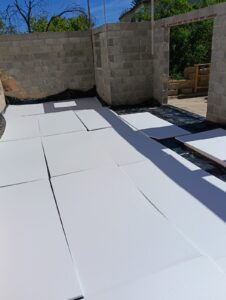
In Alicante, external thermal insulation via ETICS improves the building envelope against heat, humidity, and solar radiation. The most common materials are EPS and graphite EPS (high performance and good cost/benefit balance), mineral wool (better acoustic and fire performance), and expanded cork (breathable and stable in Mediterranean climates). Correct continuous external installation reduces thermal bridges in Alicante residential facades and promotes summer comfort.
Cavity wall insulation is ideal for buildings with an existing air cavity, requiring no major construction work. Loose-fill mineral wool, treated cellulose, or EPS beads with graphite additives are used to fill the cavity and reduce internal convective currents. Before insufflation, it is advisable to verify the continuity of the cavity and potential moisture issues to ensure adequate densities and homogeneous sealing.
For roofs in Alicante homes, resistance to heat and humidity is sought. On flat roofs, XPS (high compressive strength and water resistance) and spray polyurethane are common for continuity, always protected with proper waterproofing and barriers; on pitched or ventilated roofs, mineral wool or sandwich panels with PIR/PUR are prominent. High-reflectance finishes and ventilated cavities help reduce summer heat gain.
Efficient windows combine PVC or aluminum frames with thermal break and double or triple glazing with low-emissivity coating and, depending on orientation, solar control. The gas-filled cavity, “warm edge” spacers, and perimeter sealing reduce heat loss and condensation. In Alicante, improving the roller shutter box and ensuring a watertight installation are key to preventing infiltrations and maximizing overall performance.
Price of Residential Thermal Insulation in Alicante: Cost per m², Energy Savings, and Payback Period
Cost per m² in Alicante
The price of residential thermal insulation in Alicante varies depending on the system and access to the area to be insulated. As an indicative reference (material + labor, excluding VAT and auxiliary works), typical ranges are:
- Cavity wall insulation (existing facades): €15–30/m².
- External insulation (ETICS type): €60–120/m² (may increase due to finishes and scaffolding).
- Roof insulation (rigid panel or mineral wool): €30–70/m².
- False ceilings/interiors (mineral wool + board): €20–45/m².
- Spray foam on floor slabs or under roof: €25–50/m².
Prices depend on the condition of the home, thermal bridges, thicknesses, insulation continuity, and prior repair needs.
Estimated Energy Savings
In Alicante’s Mediterranean climate, insulation primarily reduces cooling demand in summer and also heat loss in winter. With specific interventions (e.g., only facades or only roofs), heating and cooling savings of 15–30% are common, while more comprehensive envelope interventions (facades + roof + thermal bridges) can achieve savings of around 25–40%. The actual result depends on existing insulation, orientation, airtightness, shading, and quality of execution.
Payback Period
The payback period is calculated based on investment, current consumption, and energy price. As a guide, cavity wall insulation typically pays for itself in 2–5 years, roof insulation in 4–8 years, and ETICS systems in 6–12 years. In homes with intensive use of heating/cooling or high energy prices, the payback period is shorter and can be further reduced if available aid or deductions in the Valencian Community are accessed.
Regulations and Aid in Alicante for Residential Thermal Insulation (CTE, Next Generation, IBI)
CTE in Alicante: Key Insulation Requirements
In Alicante, the Technical Building Code (CTE) mandates limiting the energy demand of homes through adequate thermal insulation of the building envelope. The basic document DB-HE Energy Saving requires controlling the transmittance of facades, roofs, and openings, reducing thermal bridges, and ensuring airtightness, with values depending on the climatic zone of each municipality. These requirements apply to new construction and rehabilitation when intervening in the building envelope, and must be justified in the project and with the energy performance certificate before and after the intervention.
Next Generation Aid for Residential Insulation
The Next Generation aid from the Recovery Plan finances energy rehabilitation actions in Alicante, including thermal insulation of facades, roofs, and window replacement. They are managed through the Generalitat Valenciana and the Rehabilitation Offices, and require demonstrating energy improvements through prior and subsequent certificates that meet the thresholds established in each call. They usually cover eligible costs such as construction, materials, and technical fees, with defined application and justification deadlines and subject to budget availability.
IBI Bonuses and Municipal Procedures
In addition to subsidies, at the local level there may be IBI bonuses linked to energy efficiency improvements, as stipulated in the Fiscal Ordinance of each city council. For Alicante, it is advisable to review the current regulations of the Alicante City Council and the requirements (technical documentation, energy certification, application deadlines) that allow for accrediting the improvement through insulation. These actions may require a building permit or responsible declaration and the payment of fees, so it is advisable to verify the procedures before starting the work.
How to Choose a Company for Residential Thermal Insulation Installation in Alicante: Certifications, Guarantees, and Process
Certifications and Accreditations
To choose a thermal insulation company in Alicante, verify that it is registered in the REA (Registry of Accredited Companies) of the Valencian Community and that its team has specific training in safety and work at height if working on facades. Demand compliance with the CTE (DB-HE Energy Saving) and use of materials with CE marking and Declaration of Performance (DoP); for ETICS systems, request ETA/EAD and applicators approved by the manufacturer. Certifications such as ISO 9001 (quality) and ISO 14001 (environment) add solvency.
Guarantees, Insurance, and Documentation
Request a written guarantee detailing labor and material coverage, as well as valid civil liability insurance. The company must provide technical data sheets, DoP, and product certificates, in addition to a maintenance manual for the installed system; some include post-work verification (e.g., thermography) and can assist with the update of the home’s energy certificate. Review that the contract reflects the exact scope (items and measurements), deadlines, management of municipal licenses and waste removal, as well as support for possible public aid in the Valencian Community.
Work Process
A reliable firm in Alicante should conduct a technical visit to diagnose thermal bridges, condensation, and the condition of the building envelope, proposing viable solutions with a technical report and work plan. It must define a schedule, property protections, quality control, and minimization of noise and dust. It is advisable for them to manage the minor building permit and, if applicable, the public road occupation with the Alicante City Council or nearby municipalities, coordinating with the homeowners’ association. Upon completion, request a handover certificate with documentation, maintenance recommendations, and after-sales contact.